
Jim Miller, The Jumping-Off Place & SD350 Board Member
Article by The Jumping Off Place
“Democrats who already have an advantage on climate and renewable energy with votes and should lean into rather than away from climate by emphasizing affordability and climate costs.”
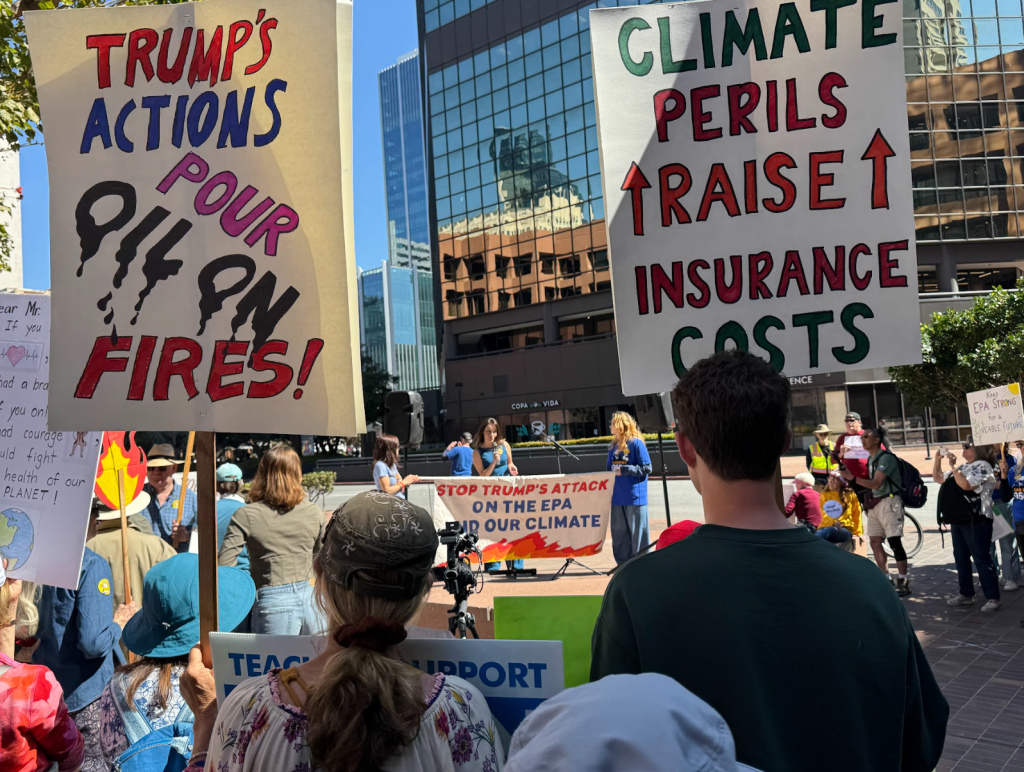
San Diego is heading the wrong way on climate. As the rest of the nation has responded to the reactionary bent of national politics and the environment by largely abandoning or sidelining the issue, one might have hoped that cities like all-blue San Diego could serve as a counterweight but, alas, such is not the case. In recent weeks, a new report was issued noting that our emissions were up, which illustrates that despite our historic climate action plan, we are moving in the opposite direction to where we should be going.
It seems that San Diego was content to notch an aspirational victory without enough real action to back it up. Of course, some might claim that this is understandable, politically speaking, with Democrats in California and elsewhere scrambling to embrace “affordability” as a game changing issue. Granting too much attention to the environment could be a politically costly diversion, some argue. But that thinking, loudly embraced by “centrist” Democratic forces, is misguided.
As Gabrielle Gurley of The American Prospect argues in “The Cost of Climate” the economics versus environmentalism debate misses the point that climate change carries huge costs of its own:
Climate change is an affordability issue that demands reassessing the pearl-clutchers’ claims that expensive solutions only burden people with higher costs. This era’s threats should prompt the realization that inaction (or worse, retrenchment) is prompting price hikes right now, which people find intolerable. By contrast, the policy responses and environmental adaptations needed to grapple with the crisis can potentially decrease consumer prices, as the progress in the renewable-energy sector shows.
A warming planet can cause more suffering, more disease, and even mass deaths. But even if you don’t live in a danger zone made more treacherous by climate change, the higher prices you pay for everyday goods—even something as basic as water—mean that no one escapes the impacts.
Indeed, another new study by the UC Berkeley Center for Law, Energy, and the Environment, outlines how the financial impact of climate change, particularly in a state like ours, which is subject to many climate-related disasters. In the United States, households will continue to face increases in food prices, energy, and insurance, along with lost wages, health expenses, and a wide range of other financial burdens. Last week, I was fortunate to hear a talk by Kasia Kosmala-Dahlbeck, a Climate Change Policy Research Fellow at the Center, who noted that in their lifetimes, average Americans are likely to pay around one-million dollars in climate costs. Thus, we are not talking about chump change.
Beyond debunking the misconception that climate politics are bad economic politics, the reality is that the opposite may be true. In the The New Republic, Aaron Regunberg observes that:
A majority of voters say they believe climate change will have a direct financial impact on their families. Millions of voters are already feeling the pain of skyrocketing home insurance rates, which are driven by the increased risk of severe weather from climate change. Millions more are confronted each year with the staggering costs of disaster recovery from extreme weather events exacerbated by the climate crisis. And a strong majorityof Americans are struggling with rising electricity prices, a problem that just 5 percent of voters blame on renewables versus corporate profits (38 percent), data centers (14 percent), and grid pressures from extreme weather (11 percent). On the flip side, expanding clean energy is the fastest way to produce cheap electricity needed to lower utility rates—and Democrats hold a massive trust advantage over Republicans when it comes to clean power.
Consequently, Democrats who already have an advantage on climate and renewable energy with voters, should lean into rather than away from climate by emphasizing affordability and climate costs. Indeed, a populist economics that intelligently embraces climate politics could very well be part of the answer when it comes to winning the 2026 midterms and the future.
Regunberg cites a recent polling memo that lays out a possible roadmap:
“Heading into 2026,” the memo reads, “Democrats have a chance to define themselves as the party that will build the cheapest energy, crack down on profiteering, and make polluters, not families, pay for the climate damage they’ve caused.” That is, substantively, a great climate agenda. It’s also a winning electoral message, and one Democrats should be running on, not from.
Let’s hope we see candidates embrace this thinking here in San Diego and across the state and the nation. There’s no point in winning power back if we can’t speak to the central existential threat of our time.