Satirical Poem

Mrs. Man

She’s like the weather, he laughs,
moody and unpredictable;
but maybe she, like the sky and the sea,
has to accept what he does, this Man
who dresses her up in jeweled cities
and keeps her warm during winter
with carbon blankets and methane booze.

She’s like the weather, he quips,
moody and unpredictable;
but maybe she’s not consulted
about his plans for her, his expectation
that she’ll be fruitful and multiply.
Lord knows, he provides her with enough
genetically-modified fertilizer.

She’s like the weather, he rags,
moody and unpredictable;
but maybe this Man puts himself first,
like the time he spent the week-end
playing nuclear roulette with his buddies,
leaving the whole carcinogenic mess
for her and the grandkids to clean up.

She’s like the weather, he repeats,
moody and unpredictable;
but maybe her barometric pressure’s just up,
what with his unreasonable insistence
that she be nice to his clients
who get high on fracked gas
and vomit crude in the domestic pool.

She’s like the weather, they’re now saying,
moody and unpredictable;
so maybe she should ask herself
if he’s really worth all that soot,
draped like a pall on her dawn.
But she, with nowhere to go,
must hold on to this Man, her hope.

18 May 2013


Creative Commons License
This work is licensed by Bonnie Mosse Funk under a Creative Commons Attribution-NoDerivs 3.0 Unported License.

Global Warming Stalled?


WHERE THE “MISSING HEAT” HAS GONE

The years since the turn of the 21st century have seen a temporary lull, or pause, in the rise of global atmospheric temperatures.  Yet the causes of rising temperatures — especially the burning of fossil fuels that increases the atmosphere’s CO2 burden — are still with us.  So where has the excess heat been going for the last decade or so, if not into the atmosphere?  This question has generated a flurry of inquiry by climate scientists.  The results of their recent research, added to an already vast store of data about global warming, point to the ocean’s depths as the repository of the missing heat.

A graph of the Global Land-Ocean Temperature Index clearly demonstrates the warming trend that has characterized the climate since the beginning of the 20th century — the ten warmest years of the 132-year record having occurred since 1998.

Following the 5-year running mean on the graph, we see that steep rises are offset at intervals by pauses, some brief and others more extended.  In particular, we see a pause beginning around the turn of the 21st century and continuing into the present.  Given the overall upward trajectory seen on the graph, we might reasonably expect that this current pause will end as they all have, and the rise in temperature will resume apace.  In fact, climate scientists have been predicting this for the longer term.  A statement issued in March of 2011 by Britain’s Meteorological Office reads,

“… even if greenhouse gas emissions are substantially reduced, the long lifespan of CO2 in the atmosphere means that we cannot avoid further climate change due to CO2 already in the atmosphere. […] Despite the uncertainties, all models show that the Earth will warm in the next century, with a consistent geographical pattern.”

This statement clearly affirms what is currently understood about future global warming.

A lull in the overall rise in atmospheric temperature may be newsworthy, and it has drawn a number of news outlets to seize upon it as if it were a new trend.  The message in a recent Fox video broadcast is that climate change has stalled.  That would certainly be good news for our planet, if it were true.  But this message relies on a selective reading of the data, “global temperatures have remained flat over the last ten years” being the only reference to climate history in the broadcast.   Such an interpretation singles out 10 years showing a short-term pause, while it ignores over 130 years of data showing the long-term rise in global temperatures.

Selecting only a portion of the data that conflicts with the data as a whole is cherry-picking, a tactic commonly used to misinform the public.  As is typical of cherry-picking, the picture is incomplete and leads to a false conclusion.  The whole of the data gives the complete picture: that atmospheric temperatures have been rising, despite pauses, for well over a century.

Over the decade or so of the current lull in temperature rise, climate scientists have continued to monitor Earth’s climate systems in an effort to discern how these pauses in a long trend of atmospheric warming occur.  What they have come to understand is that the ocean’s depths have been absorbing the preponderance of the missing heat; in fact, the temperature rise in the deep ocean – below 700 meters – has even been accelerating since the turn of the 21st century.  This acceleration in the rise of deep ocean temperatures contrasts with a deceleration in the rise of the ocean’s surface temperature, and the corresponding pause in the rise of atmospheric temperatures.

Balmaseda _et Al ._ocean _heat _content

Source:  Balmaseda et al., (2013)

During this pause, Earth’s overall climate is simply undergoing a redistribution of heat between the two systems, atmosphere and ocean.  The ocean, by absorbing over 93% of the excess heat, strives to “catch up” to the previously faster-warming atmosphere.  Warmed by the atmosphere, surface water is drawn down to the depths where it mixes with the colder water, gradually warming the depths.  This dynamic overturning of waters also brings colder water up to the surface, where the temperature rise has seen a deceleration. Thus, the current pause in the rise of atmospheric temperatures does not mean that global warming has stalled, but rather that its locus is the depths of the ocean.

Retrospectively tested computer models show that for the rest of the 21st century, as atmospheric temperatures continue their rise, there will be other temporary pauses, or periods when temperatures level off, like the one we are experiencing now.  Commenting on a study of such computer models conducted by the National Center for Atmospheric Research, climate researcher Kevin Trenberth speaks to this future:  “This study suggests the missing energy has indeed been buried in the ocean. The heat has not disappeared, and so it cannot be ignored. It must have consequences.”

Reinforced by mounting scientific evidence, Trenberth’s warning tells us this current pause must not be construed as a reason to relax vigilance.  We must continue to advocate for policies that discourage fossil fuel consumption and encourage the development of other sources of energy.  Pauses in the inexorable rise in global temperatures are just that:  only pauses – and they are part of the overall picture of continuing global climate change.


The Bronze Bird


flickr_lagohsep_oiled_pelican_475x250_100603

http://www.propublica.org/blog/item/photo-of-the-day-pelicans-drenched-in-oil


image (3)

http://www.boston.com/bigpicture/2010/06/caught_in_the_oil.html


The Bronze Bird

After the taxidermist

ties up his work,

immerse the  pelican

in molten metal,

an elegant bronze

the color of oil –

swirly on water,

deadly on feathers.


Over long months

oxidation draws

from the bronze

a verdigris patina,

color of the gulf

he flew over

the year before.


Creative Commons License
This work is licensed by Bonnie Mosse Funk under a Creative Commons Attribution-NoDerivs 3.0 Unported License.


Not Just for Tree Huggers

Citizen’s Guides to Climate Change: How to Sort it All Out without Getting a PhD

This posting is the third in a series on how you can figure out what’s going on with climate change, without having to get a PhD in climatology and without going crazy from the conflicting messages in the media. My first post showed how you can bypass the media confusion by finding out what real scientists are saying. My second one showed how strongly scientists agree on the basic facts: Earth is warming. We’re causing it. The biggest contribution is burning fossil fuels, which accumulates heat-trapping gases such as carbon dioxide in the atmosphere. We need to burn less fossil fuel to keep the effects from getting too extreme.

In this post, I’d like to acquaint you with some of the people besides scientists who are concerned about climate change. Some of them may surprise you. Who they are and what issues they identify may give you a sense for why mitigating climate change is important for all of us.

It is no surprise that environmentalists call for climate action. If we continue increasing fossil fuel consumption, people who are small children today could experience, within their lifetimes, an increase in earth’s average surface temperature of 2 to 5 ºC (4 to 9 ºF), which is nearly as great as that between the last Ice Age and today. That rapid change would disrupt ecosystems all over the world. As warming exceeds 4 ºC, there is a risk of major extinctions, involving 40 to 70 % of the plants and animals assessed in the 2007 report of the Intergovernmental Panel on Climate Change. We can preserve much more of the natural world if we burn less fossil fuel and limit the warming to 2 ºC or so. Because extinct species are gone forever, the decisions we make over the next few decades will determine how much poorer a world we leave to every human generation that comes after us.

What you might not have guessed is that the American Academy of Pediatrics, American Medical Association, World Health Organization and other groups concerned with human health are also calling for action to minimize global warming and prepare healthcare systems to cope with it. These groups point out that climate change can affect people’s health in a variety of ways, including extreme heat and drought that hurt agriculture and increase malnutrition; injury and disease from more severe floods and hurricanes; water pollution due to flooding and drought; higher temperatures that worsen the chemistry of air pollution; and expanded ranges of pests that spread disease.

Another group taking climate change very seriously is the American military. Recent reports from the US Department of Defense and intelligence agencies have looked at climate change as a concrete threat to national security. Global warming brings more drought to places already too dry, more flooding to places already plagued by floods, and less food and water to people who already have too little, especially in parts of Africa, South Asia, the Middle East and the Caribbean where social tensions are high, governments are weak and resources for coping with disaster are lacking. In such places, the added climate stresses may exacerbate existing risks of violence and political instability. As the military describe it, global warming is a threat multiplier.

We have already seen violence exacerbated by the kinds of environmental stresses that climate change will increase. The genocide in Darfur, for example, may have happened in part because expanding deserts forced herders into land occupied by farmers with different tribal, ethnic and religious identities. Violence has also occurred in India between natives and migrants forced out of Bangladesh by flooding and rising sea levels. As global temperatures rise, the environmental stresses and the resulting conflicts will continue to increase.

Although the military have focused on climate change as a destabilizing force in poor countries, it is a very real problem for richer ones as well. The US Department of Agriculture has been looking at how global warming might affect food production in the United States. The effects they describe are complicated, difficult to project, and likely to vary by crop and by region. However, some of the most recent analyses indicate that, if fossil fuel burning increases as it could well do, corn and soybean yields in the US could fall by as much as 60 to 80% by the end of this century. The losses will be much less if we minimize the global temperature change by burning less fossil fuel.

As these crop-yield projections illustrate, radically changing the climate can have real economic consequences that are potentially serious but hard to predict. One group that knows about dealing with uncertain risks of economic loss is the insurance industry. Many leading insurers, noting the ongoing increase in the number and severity of weather disasters, have called for action to minimize climate change. Another leader in insurance, Lloyd’s of London, has looked at climate change from a broader business perspective. They start with the overwhelming scientific evidence for human-caused climate change. They then identify a number of consequences that could affect businesses worldwide:

  • Water scarcity
  • Food production not meeting demand
  • Risks of mass migration from poor to rich countries
  • Risks of increased international conflict and insecurity
  • The increased unpredictability of a warmer world

The American Academy of Pediatrics, the Departments of Defense and Agriculture, and Lloyd’s of London are looking at climate change not as environmentalists, but because it is their job to assess risks and plan for them. Looking at the same science from somewhat different points of view, they each find that global warming presents significant challenges for our society.

A common thread in their analyses is that climate change can affect our lives in complex ways, with potentially big, but imperfectly known consequences. Climate change is about making choices in the face of imperfect information. Doctors, generals and insurance companies do that all the time. What we know for certain is that we have a real problem, and that the risks will increase as global temperatures rise. Our choice is how much risk we want to tolerate, and how quickly we are willing to reduce our consumption of fossil fuels. The more quickly we do that, the richer and more secure will be our world and the one we leave to our children.

Creative Commons License This material by William F. Avrin is used here by permission of the author, and is licensed under a Creative Commons Attribution-NonCommercial-ShareAlike 3.0 Unported License.


Open letter to the California Federation of Teachers

California Teachers for Fossil Fuel Divestment and SanDiego350.org sincerely thank the California Federation of Teachers for backing a resolution calling for CalSTRS and CalPERS to divest from fossil fuels. Your bold step in asking the two largest pension fund investors in the United States to remove the collective wealth of the education workers you represent, workers that spend their professional lives preparing others for the future, from being used in the fossil fuels industry, is the kind of tectonic shift this world needs.

Climate change must be addressed now and that means radically reducing our dependency on fossil fuels. Every fossil fuel tentacle, every branch that can be cut moves us forward in stopping our dependency on fossil fuels. The tentacle you have asked to be cut is a tentacle that relies on the income produced from investing in fossil fuels. There is no denying that the fossil fuel industries provide the best return, the best bang for the buck, and we have a significant amount of our collective wealth in our CalSTRS and CalPERS pensions invested in fossil fuels. However, we must look beyond today, this quarter, this year; we must think about the coming decade or two.

The science of climate change is very clear; we have at most a decade to begin taking bold action to avoid the worst that climate change could bring. So we are faced with a choice: begin significantly cutting our fossil fuels dependency now and maybe face an economic issue manifested to us in CalSTRS and CalPERS by a drop in investment revenue brought in by fossil fuels, or don’t cut our fossil fuel dependency and face broad environmental and social catastrophes unheard of by humankind.

If in this critical decade, we the people demand real action on climate change and that demand is followed by real action to greatly reduce our carbon dioxide emissions, the value of fossil fuel stocks will drop and those holding them will take the hit. Action on cutting carbon dioxide emissions doesn’t mean that we don’t provide alternatives in energy, and investing in these alternatives on a scale to meet the demand of replacing fossil fuels presents great opportunities for pension funds like ours.

If action isn’t taken on carbon dioxide emissions, the continued holding of fossil fuel stocks may not matter much in the decades ahead. As our youngest teachers begin to retire, what effect will our current choice of investments have on their future? Global insurance firms, military planners, government agencies dealing with water for agriculture and inland water transport, and many coastal communities and nations all see climate change as the most significant threat to the future for maintaining stable societies everywhere. How will a portfolio heavily invested in fossil fuels look thirty years from now if the threat of climate change is real? What future will there be for our students?

Divesting from fossil fuels is not just a sound proactive step to protect our collective wealth; it is an action that speaks to others that now is the time for action, for after now there will be no time left to make a difference. We ask you to go to our website, www.teachersfordivestment.com, and sign our petition. It’s going to take all of us working together to bring about the change that is needed. It will take the kind of leadership the CFT showed in choosing to support the resolution for fossil fuel divestment. CFT has boldly stepped forward and reinforced that California educators are about preparing others for their future, and that their students will not be facing a radically different planet due to climate change. We at California Teachers for Fossil Fuel Divestment and SanDiego350.org applaud your actions.

Thank you,

Gary Waayers

Member of: AFT Guild 1931; Palomar Faculty Federation;
California Teachers for Fossil Fuel Divestment;
SanDiego350.org

Tactics of the Misinformation Machine

In an online video — abetted by the occasional on-air aside — a local weather broadcaster presents information contrary to conclusions accepted by 97-98% of climate scientists.  This makes him a local voice for the misinformation machine.  His voice can be heard re-tooling old tactics as he seeks to dispute the ever-increasing evidence that humans have altered Earth’s climate.

A common tactic used by the misinformation machine is the attempt to discredit – without evidence – the source of valid climate-change information.  Typically, he makes the unsupported claim that government-sponsored entities such as the National Science Foundation will fund only studies that promote the global-warming scare.  The only possible purpose for such an unjustified claim is to engender cynicism about science – cynicism that will be available for exploitation in the future.  By seeding doubt, the misinformation machine pre-sets the tone they hope will enable them to question hard-to-swallow conclusions soon to arrive.

As a matter of principle, scientists insist on certainty.  During the long period of accumulating sufficient data, the climate scientists themselves have been withholding their anticipated conclusions.  For example, in her online video, climate scientist Katherine Hayhoe does not allow herself to be drawn prematurely into concluding that recent extreme weather events are caused by climate change, despite her acceptance of the data so far.  While such reticence is clear evidence of professional integrity, the misinformation machine misrepresents it as doubt or, by a hyper-extension of logic, as a lack of consensus among climate scientists.  In this way, the misinformation machine tries to use the principled caution of climate experts to undermine the public’s perception of the climate science community, so they will not be heeded when the time comes – and it’s not far off – that the science about extreme weather events is secure.

Climate science and the data that support it may seem esoteric, but weather itself is not.  Weather is something we of the public all experience, which makes it a form of common knowledge.  To exploit our common experience of the weather, one attempt to confuse the public is to point out – using the following historical weather data chart below as a visual aid – that temperatures world-wide are rising by “only” tenths of degrees (as seen on the vertical axis.)

                        Average global temperature over the last ~2,000 years.                                       Note the massive uptick on the far right side. (Science)

We of the general public, in our day-to-day experience of weather, might easily be convinced to see this trend as insignificant – after all, what’s a degree or so, one way or the other?  Such an interpretation deceptively leaves out the climate-history context that the last Ice Age came about because of a drop of “only” nine degrees in overall mean world temperature. As if that weren’t enough, the misinformation machine ignores “the massive uptick” of the last half century, which really clarifies the relationship of current weather to historical climate changes.

Blustering forward, the misinformation machine goes on to ridicule the historical research itself, which uses data collected from ice cores and fossilized life forms.  Seemingly esoteric, such research is easy for a non-scientist commentator to dismiss as irrelevant.   And thus it becomes apparent that distorting, ignoring and deriding the data is the only tactic available when those data have become so overwhelmingly supportive of climate change.

The misinformation machine seeks to frame public perception of the expected conclusion:  climate change does indeed have a causal relationship to recent extreme weather events.  When this conclusion arrives — as given the trajectory of the extreme-weather-events data it inevitably will — it will be irrefutable on scientific grounds.   For this reason, the purveyors of misinformation have been trying to prepare the public mind to reject it.  But  obfuscating tactics will fall before the clarity of overwhelming science.


Comprehend the Consensus

Citizen’s Guides to Climate Change: How to Sort it All Out without Getting a PhD

Scientists are telling us clearly that we’re changing the climate and need to do something about it. Yet, what we hear in the media can be so confused that many people feel they can never figure out what to think about climate change. If you feel that way, this posting is the second in a series on how you can get to the truth about the climate.

My first post showed how you can get started by finding out what actual scientists are saying, rather than trying to puzzle out the Al-Gore/talk-radio argument that the media sometimes make climate science seem to be. A good next step is to appreciate just how strongly and consistently scientists agree on the essential facts of climate change.

One expression of that consensus is in the statements on climate change by science organizations all over the world. Those organizations include the national science academies of at least 32 countries (links: 1,2,3,4,5). They include professional organizations in earth sciences (6,7,8,9,10), meteorology (11,12,13,14,15), physics, chemistry and biology. They also include the National Academy of Sciences, America’s foremost science advisory board, whose members serve without pay and are elected for distinguished achievement. These statements all affirm certain basic facts: The climate is changing. It is virtually certain that we are causing it. We need to burn less fossil fuel, to stop heat-trapping gases such as carbon dioxide from accumulating in our atmosphere.

A 2010 article in the Proceedings of the National Academy of Sciences took another approach to sizing up the scientific consensus: They counted. The authors identified the community of scientists who are most actively working on climate change, based on the number of peer-reviewed scientific papers each scientist had published, and how often those papers had been cited by others in the field. They looked at all the papers that those scientists had published. They then counted up how many of the scientists supported or challenged the basic understanding of human-caused climate change summarized in the Assessment Reports of the Intergovernmental Panel on Climate Change. They found that 97 to 98 percent of the scientists actually working on climate change supported that common scientific understanding. Other studies have found similar results. That nearly unanimous agreement among climate specialists, together with the supporting statements by national academies and professional organizations in related areas of science, indicates that scientists are in overwhelming agreement about the reality, human causes and urgency of climate change.

Another measure of how well settled the science of climate change is, is how consistent the scientists’ understanding has been over time. You can see that consistency in the very first Assessment Report of the Intergovernmental Panel on Climate Change. In that 1990 report, scientists reviewed the research up to that time, and summarized what we knew then about climate change. They identified most of the key points that you can see in the most recent Assessment Report from 2007. To list just a few of the biggest ones:

  • Global warming happens because we are accumulating carbon dioxide and other heat-trapping gases in the atmosphere, mostly by burning fossil fuels such as coal and oil.
  • We know the warming will happen both from the physics of the climate system and from geologic records that tell us about past climates.
  • The details of how the climate changes depend on the behavior of clouds, snow, ice, water vapor, winds and ocean currents, which affect and are affected by the warming.
  • We can see the warming trend in records from weather stations, satellites, balloons, buoys and other tools that measure land, sea and atmospheric temperatures, as well as sea level rise and the retreat of glaciers.

That warming trend was measurable by 1990, though the data weren’t yet strong enough to rule out natural fluctuations as the cause. By 2007, the trend was unmistakable, and the scientists estimated that there was less than a ten-percent chance that anything other than human causes could explain all their measurements of trends in different aspects of the climate. The main change in the science was that the understanding had gotten clearer, a few apparent anomalies had been resolved, and the evidence supporting the basic model had become even more massive.

These few sentences don’t nearly do justice to the amount of evidence that supports the scientific consensus. Indeed, one of the remarkable things about global-warming science is the sheer number of different ways in which the scientists have checked and cross-checked their understanding.  The National Research Council, an agency associated with the National Academy of Sciences, has a 40-page booklet that summarizes some of the many lines of evidence in language that non-scientists can understand. I hope to show you a few examples in future postings.

This posting’s bottom line is simple but crucial: You might not hear it on TV, but scientists have reached an overwhelming consensus that climate change is real, happening now, human-caused, and a problem we urgently need to deal with. Knowing that matters because, once people hear how strong the scientific agreement is, they are much more likely to agree that climate action now is one of our highest priorities.

Creative Commons License This material by William F. Avrin is used here by permission of the author, and is licensed under a Creative Commons Attribution-NonCommercial-ShareAlike 3.0 Unported License.

No Need to Let Your Head Explode

 Citizen’s Guides to Climate Change: How to Sort it Out Without Getting a PhD

Warming of the climate system is unequivocalMost of the observed increase in global average temperatures since the mid-20th century is very [90%] likely due to the observed increase in anthropogenic [human-caused] greenhouse gas concentrations.”

 Intergovernmental Panel on Climate Change, February, 2007

“If you want to know what’s causing global warming, listen to AM talk radio while watching ‘An Inconvenient Truth’ and simultaneously running a Google search. We’ll stand back and watch as your head explodes.”

Lenny Rudow, Boating Magazine, March, 2007

Scientists have a clear message for us: The climate is changing right now. We’re causing it. To keep the consequences from getting too bad, we need to burn less fossil fuel.

Yet, many of us aren’t hearing that message. Like Lenny Rudow from Boating Magazine, we just hear a loud argument between Al Gore and right-wing talk radio. We feel like we can never figure out who to believe. It’s easy to get that impression, because the voices of real climate scientists are barely audible in the media where most of us get our news.

You don’t have to feel like your head is going to explode. You can figure out what’s going on with climate change. You don’t need a PhD in climatology. You just need to know where to look, and sometimes a few common-sense tools for thinking about what you find.

I know, because I’ve been there. I’m a scientist, but not a climate scientist. I’ve been exploring ways to understand what science says about climate change for more than twenty years. In this and future postings headed “Citizen’s Guides to Climate Change,” I’d like to offer some sources, and ways of seeing, that have worked for me and may work for you.

A good first step is simply to find out what the scientists are actually saying. One of the most authoritative sources is the National Academy of Sciences, America’s foremost scientific advisory body. The Academy was founded by President Abraham Lincoln in 1863. Its members are elected based on their distinguished records of scientific research. They serve without pay. Their mission is to review what is known on scientific issues of importance to the country, and advise the rest of us on what that science says about the choices available to us. The Academy’s most recent review of climate change (also available in summary form) affirms the long-standing scientific consensus that climate change is human-caused, happening now and a real problem. Scientific societies all over the world have issued similar statements affirming that scientific consensus on climate change.

You should also know that there is a kind of master consensus document on climate-change science. Every several years, the Intergovernmental Panel on Climate Change brings together hundreds of scientists with expertise in every field that relates to climate. The scientists sift through thousands of peer-reviewed research papers. They assess what all that research is telling us. They send their work out for peer review by hundreds more scientists. Their Assessment Reports are pretty dense, but are our most comprehensive source for what we know about climate change, how well we know it, and what we need to know better.

Finally, if you’re a little technically inclined, you might check out realclimate.org, a blog maintained by working climate scientists for journalists and the public. Even if you don’t get all the details, you can get a sense for the thoughtfulness and depth with which real climate scientists think about the evidence. It’s a far cry from the shallowness – the thin-ness – of the bogus arguments we hear from climate denialists.

The take-home message is simple: Climate change is not about believing Al Gore versus talk radio. It’s a matter of solid science. If you know where to look, it is easy to find out what the real scientists are saying. They are sending us a clear message: We have a problem. It’s up to us to fix it.

Creative Commons License This material by William F. Avrin is used here by permission of the author, and is licensed under a Creative Commons Attribution-NonCommercial-ShareAlike 3.0 Unported License.

San Diegans Join Nationwide Protest Against Keystone XL

By Jeffrey Meyer

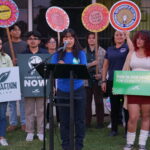
Mayor Bob Filner and over 500 San Diego protestors in Mission Bay Park joined similar rallies in cities across America Sunday in protest of the Keystone XL Pipeline project, beginning a massive effort to demand President Obama block it and call for leaders at all levels to take action to fight global warming. (Watch coverage on 6 TV stations)

Speaking at the San Diego rally, Mayor Bob Filner expressed his concerns about Keystone, climate change and what he wants to do in San Diego.

Mayor Bob Filner (photo by Diane Lesher)

“If we’re going to save our beaches in San Diego, we need to take our heads out of the sand, especially the tar sands,” he said, imploring the Mission Bay crowd to push President Obama to deny permits for the Canadian pipeline that is part of a massive proposed tar sand mining and pipeline project intended to deliver bitumen slurry to Texas coastal refineries.

Mayor Filner explained that every level of government has to take some responsibility for dealing with global warming and that San Diego can be a national leader in the use of alternative energy sources.

Link to more photos and video

“I want to have solar power in all San Diego public buildings within the next five years,” he said.  “San Diego can lead the nation in the use of alternative energy and moving away from fossil fuels.”

Part of a nationwide protest, with the major rally drawing an estimated 35,000 people today in Washington D.C.,  numerous San Diego groups participated in the rally, cheering numerous speakers,  waving banners and hoisting protest signs.  Major organizers locally were  sandiego350.org, Citizens Climate Lobby, the Sierra Club, the Environmental Health Coalition and Greenpeace.

Also, speaking at the rally, Dr. Jeffrey Severinghaus, director for the Scripps Institution of Oceanography Climate-Ocean-Atmosphere Program, said there is an abundance of misinformation about climate on the public airwaves making real climate science more needed than ever.  About 98 percent of climate scientists and researchers around the world agree with Severinghaus that humans, and not nature, are the source for the additional CO2 that is causing global warming.

“There is no such thing as Republican physics or Democratic physics.  Physics is physics.  Accurate science is desperately needed, now more than ever, and that is why I’m speaking up   We need to draw a line in the sand on the use of tar sands,” he said.  “Those who will suffer the most are not yet born.  We need to act now and speak for them.”

Banner on the I-5 overpass (photo by Alex Turner)

He noted San Diegans should show support for a new bill bill to curb carbon pollution introduced this week by Sens. Bernie Sanders (I-Vt.) and Barbara Boxer (D-Calif.).  “You need to let Boxer know you have her back,” he said about the new bill which has an estimated tax potential of more than a trillion dollars and would be invested in sustainable energy programs, with a large portion returned to taxpayers.

Former State Assemblywoman and present Chair of the Executive Committee of Sierra Club, San Diego chapter, Lori Saldana, also spoke at the rally, offering her perspectives on Keystone and climate change. “We’re here today as part of a nationwide call for President Obama to step up to the plate and stop the Keystone Pipeline once and for all – and to begin implementing policies to reduce greenhouse gas emissions, something that California pioneered,”  she said.

Another speaker, Rev. Dr. Beth Johnson, minister of Palomar Unitarian Universalist Fellowship in Vista, who has been involved in the environmental movement  for over 20 years,  said “Everything is connected and everything is at stake.”

Elizabeth Perez-Halperin, a Native American, military veteran and green business owner, said “My Native American roots and military experience have influenced me to become an environmentalist and conservationist. The threat of not protecting our environment is a national security issue.”

High-schooler, Tierra Gonzalez-Hammonds (daughter of Lorena Gonzalez, labor leader and candidate for the 80th Assembly District), also spoke, addressing her concerns about her generation’s future in a heated world.

Franco Garcia, of the Environmental Health Coalition, talked about the impacts of climate change on some of the people hardest hit locally. Simon Mayeski, a member of SanDiego350.org, said “It is of utmost importance that President Obama ‘see the light’, show us the leadership we need and reject the XL Pipeline. We need long-term clean energy relief, not a short-term CO2-laden fix.”

Scientists expect the sea level to rise at least three feet by 2100 due to global warming caused by CO2 generated by our use of fossil fuels.  This means that much of Mission Bay and the San Diego area will be covered in several inches of sea water at high tide, and we will have enormous areas subject to flooding during storms.  Sandy beaches up and down the coast could be washed away, destroying property values, wildlife habitat and tourism.  Key climatologists believe the exploitation of tar sands and our relentless release of CO2 will tip our planet’s temperature into a catastrophic nightmare, and unless action is taken now, they say the damage will be irreversible.

Rally banners (photo by Dennis Griffin)

World Bank call to “Turn Down the Heat”

The World Bank has released a new report called Turn Down the Heat: Why a 4°C Warmer World Must Be Avoided. It is the first major report to acknowledge we are not likely to succeed in keeping temperatures below 2°C warmer. The report discusses how the poorest countries will suffer most from the devastating impacts of climate change and aims to instill a sense of urgency in world leaders.

From the foreword by World Bank President Jim Yong Kim:

“It is my hope that this report shocks us into action. Even for those of us already committed to fighting climate change, I hope it causes us to work with much more urgency.

This report spells out what the world would be like if it warmed by 4 degrees Celsius, which is what scientists are nearly unanimously predicting by the end of the century, without serious policy changes.

The 4°C scenarios are devastating: the inundation of coastal cities; increasing risks for food production potentially leading to higher malnutrition rates; many dry regions becoming dryer, wet regions wetter; unprecedented heat waves in many regions, especially in the tropics; substantially exacerbated water scarcity in many regions; increased frequency of high-intensity tropical cyclones; and irreversible loss of biodiversity, including coral reef systems.

And most importantly, a 4°C world is so different from the current one that it comes with high uncertainty and new risks that threaten our ability to anticipate and plan for future adaptation needs. The lack of action on climate change not only risks putting prosperity out of reach of millions of people in the developing world, it threatens to roll back decades of sustainable development.”

Read more: